


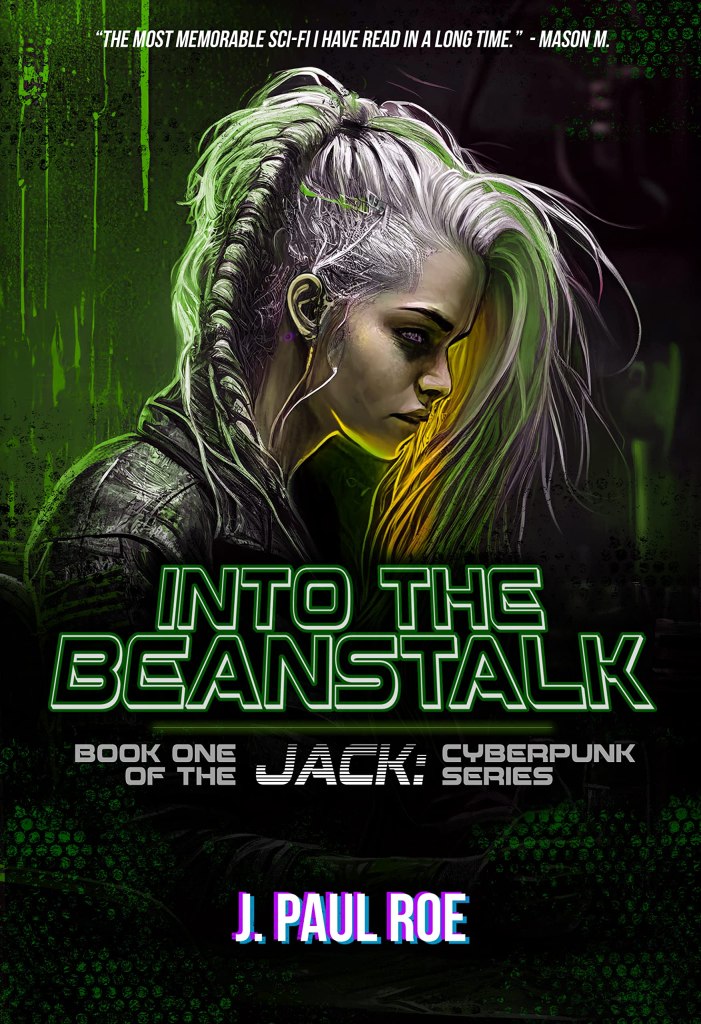
Written by J. Paul Roe
There’s always something to be said for a high concept story. Regardless of whether it works or not, it provides readers something they don’t see all the time. When it infuses disparate elements that ordinarily wouldn’t go together, it yields intriguing results. It is these disparate elements that led me to Into the BeanStalk. I’m a fan of both cyberpunk and fairy tales, so a book infusing the two grabs my attention. Into the Beanstalk, the first book in J. Paul Roe’s Jack: Cyberpunk series, is an interesting blend of cyberpunk and Jack and the Beanstalk.
With the original story being a fairy tale thought to have originally been penned more than a thousand years ago, it naturally leans on fantasy elements. Rather than writing a straight adaptation of the story, Roe has opted to let the original story serve as an influence to this book. There may be a character named Jack (albeit a gender-flipped one), a beanstalk (or “BeanStalk” as the book calls it) and a version of a giant. While the differences serve this cyberpunk story well, they may disappoint devotees of the original fable.
Although the book is loosely based on Jack and the Beanstalk, the elements get lost in the shuffle. Elements of the original are there, but the reader may need to look to find them. As a cyberpunk story, it features many of the hallmarks fans are familiar with, like an over-reliance on technology and corporations willing to sacrifice the good of the people in the name of profits. For the most part, the book doesn’t add much depth to these themes. The book touches upon them lightly, with only Jack’s disability, and the price her father paid for her cybernetic enhancements. Other than the protagonist telling the reader that corporations are evil, it doesn’t do much to back it up.
At approximately 233 pages on Kindle (the only way to read it). Into the BeanStalk is a brisk read. The plot moves quickly, maintaining a quick case from beginning to end. The prose is easy to follow, thanks to the clean style. Aside from the first chapter, it’s more simplistic than I would have liked, describing events without much flourish. At various points, there are minor errors and typos. While these aren’t major, they pulled me out of the book.
As the book’s protagonist, and sole point of view character, Jack narrates the book. She’s an entertaining character, but fairly two-dimensional outside her backstory. The characters surrounding Jack are also flat, with no development of their own. The supporting characters feel as though they are included for the sake of the plot.
The dialogue throughout Into the BeanStalk lacks realism. While there’s variation between characters, it’s limited to their demographic and background. The dialogue hits cliches often. Although the book takes place in a heightened reality, this dampens the realism of the world. While cyberpunk is a great medium for satire, if this was the attempt instead of realism, the book doesn’t lean into it as far as it could or, more importantly, should.
The novel includes a number of entertaining science fiction elements, which serve to flesh out its world. It’s an excellent setting that plays into the book’s plot well. The world is written in a way that feels larger than life, conveying the feeling of an overcrowded megacity corrupted by corporate greed. The future technology feels retrofuturitic as in our technology has already moved past this future in some ways, which brought me out of the story, questioning whether it’s actually set in the future, or whether it’s set in an alternate reality. Mileage will vary on this, however, and the feel of the world feels as though it’s aiming to capture 1980s cyberpunk.
While Into the BeanStalk is the first book in a series, it stands perfectly alone. The story is self-contained to the point where it doesn’t feel like there’s any more story to come. There is indeed more to come, however, with the second book, Into the Looking Glass (presumably based on Alice’s Adventures in Wonderland) is out now.
Into the BeanStalk tells an entertaining story set in a fantastic world. While the characters lack depth and the dialogue doesn’t work for me, it remains an engaging read.
Favourite Passage
A gust of rank wind blew from the denser parts of the city, driving an obnoxious little dervish of yellow sand right into my face. Strands of ice-white hair escaped from under my hoodie and poked me in the eye.
This was gonna be a good day. I could already tell.
Into the BeanStalk: Book One of the Jack: Cyberpunk Series, Chapter One: “Points”
Into the BeanStalk: Book One of the Jack: Cyberpunk Series was provided by BookSirens for the purpose of an honest review.
Into the BeanStalk is available on Kindle, exclusive to Amazon.
Note: I do not post scores for reviews on this website, but do post them on my Amazon and Goodreads reviews:
- Amazon
- Goodreads
You can follow J. Paul Roe online, via:
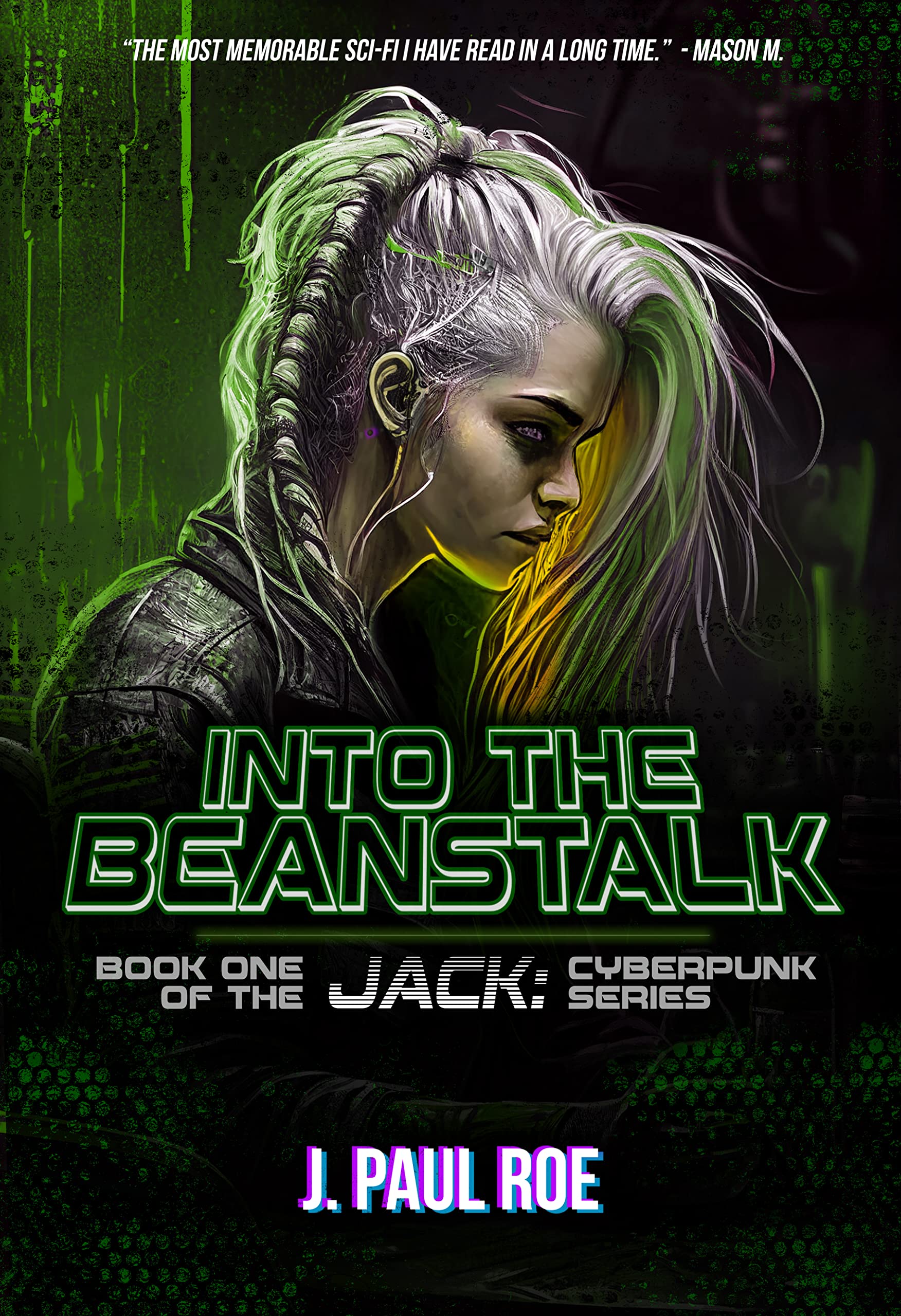
Interested in purchasing Into the BeanStalk?
Please find a link below; please note I do not collect any proceeds from the sale.
Into the BeanStalk: Book One of the Jack: Cyberpunk Series
 wastanley.com