


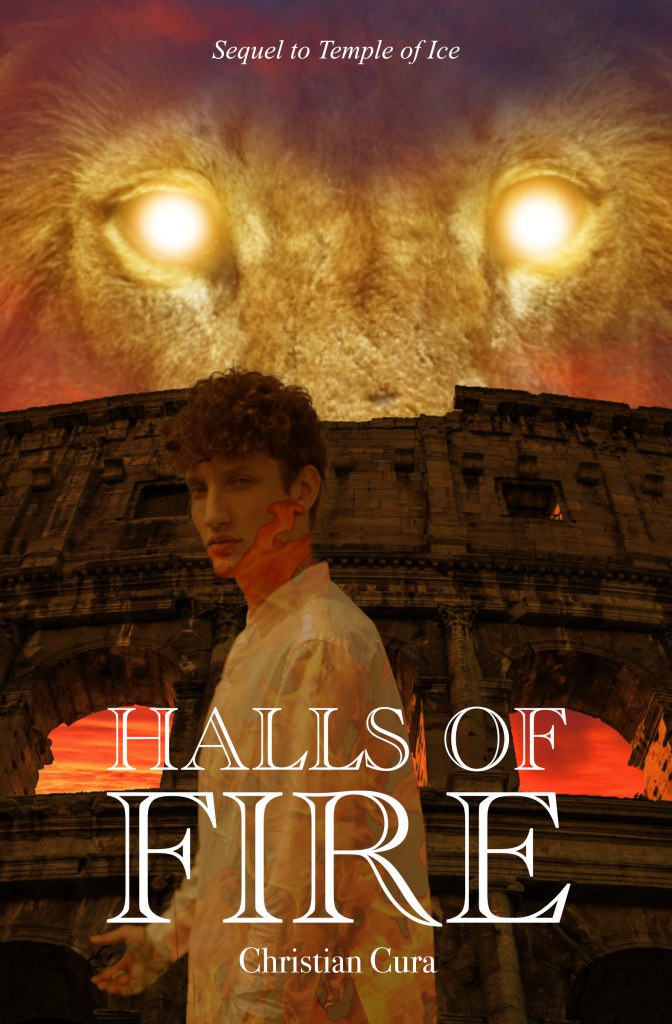
Written by Christian Cura
Ideally, sequels should stand on their own, independent of what came before. While these follow-up tales should build on those earlier stories, they should also work as standalone books. When you haven’t read the first book—which is the case with Christian Cura’s Temple of Ice—reviewing these is a tricky prospect. I can’t say how well Halls of Fire builds upon its predecessor; I can only look at it in isolation. Thankfully, this book stands on these merits.
If you’re a regular reader of these reviews, you’ll no doubt have noticed my tendency of touching upon books’ placement in a series. In a break from tradition, I’ll get it out of the way first: if Halls of Fire’s cover didn’t state “Sequel to Temple of Ice,” I would have never guessed. At no point during the book’s length (in lieu of an official page count, my eReader tells me it’s 266 pages) did I feel as though I’m missing any key information, or that my knowledge about the characters and world is missing. The book tells new readers everything they need to know, and it never feels as though the reader is dropped into the middle of an ongoing story.
The plot for Halls of Fire is a relatively straightforward affair. Upon attending “the Games,” the lead characters are attacked by creatures corrupted by a dark goddess’ power. From here, a mystery builds around the identity of who unleashed the monsters. The mysterious element works well and provides a thread for the reader to follow as the book’s secrets are uncovered. However, first and foremost, this book is a fantasy, and an epic one at that, where the mysterious elements are outweighed by the fantastical.
And boy, are the fantasy elements fantastical. From the two chapters forming the book’s prologue to its resolution, Cura has packed Halls of Fire full of fantastical elements. The book’s world is filled with mythological creatures, various monsters, and mages of various disciplines. The book takes inspiration from Native American mythology, but isn’t bound by it, instead opting to present a living, breathing world governed by its own rules of magic. Epic fantasy fans will likely love the book’s world building, and how it presents the continents of Regnum and Khione.
As massive as the scope of the book’s world is, a more intricate story that leans into both this scope and the mysterious elements would have elevated the story further. It would have also sped up the pace, allowing the story to build momentum. Instead, the story moves along gradually, without a sense of urgency. The pace increases as the book moves into its action sequences before slowing down until the next set piece.
Despite being squarely an epic fantasy tale, Halls of Fire is a brief read. While an estimated 266 pages is already short for a book set in a fantasy world, it feels even shorter than the page count suggests. The book doesn’t take long to read, and can be comfortably finished within one or two sittings. A major reason for this is the style the book’s written in. The language used is simple, which ensures most readers will be able to parse it easily, but it results in prose that lacks colour. The writing fluctuates between long and detailed paragraphs describing the world and events, and heavy dialogue-filled scenes. This dialogue lacks realism, and the characters’ voices are similar to one another. Much of this is used to provide exposition, and this results in the feeling the characters are espousing information, instead of having real conversations.
The simple writing style works well for a young adult book, as does its plot, characters and themes. However, Halls of Fire never leans into these themes to explore them. At the centre of the book is LGBTQI+ representation through a lesbian relationship, though it doesn’t explore this in depth. As important as this representation is in young adult stories, it leads to one of the key reasons I would not recommend the book to younger readers. The book’s sex scenes are explicit, with the focus being on the actions, rather than eliciting any emotion. The book’s action scenes are bloody and brutal, and instead of simply conveying the horror of its battles, it hones in on them. While explicit sex and violence have their place, it’s a shame they get in the way of a book that would otherwise work well for young adult readers.
It would be easier to connect with the bedroom scenes and worry over the battle scenes if Halls of Fire’s characters were more strongly drawn. Instead, as enjoyable as they are, the characters lack depth. Instead, they feel very much like archetypes fulfilling roles than living, breathing people.
Halls of Fire tells an entertaining tale set in a wonderful fantasy setting. The adult subject matter is stronger than it needs to be, creating a missed opportunity as a young adult book, which its themes and stylings are well suited to. But whether it’s those themes, or stylings like its prose and dialogue, or the plot and characters, it lacks a certain amount of depth. A deeper book could have elevated it into something that offers more than light entertainment.
Favourite Passage
A moment later, the mysterious blonde woman approached the table, a statue of the dark goddess clutched in both hands. What was she doing here? Her lips moved, but her words were muted by the distance. The statue glowed, and smog streamed out of it, spilling over the wolf on the table.
The beast writhed and convulsed, howling in agony. It strained against its bonds but to no avail. Beneath its skin, muscles and bones shifted. Fingers sprouted from the wolf’s paws and new vertebrae popped into existence. Its limbs grew and swelled, the bonds ripping apart.
Tama shivered as she imagined the grotesque sounds in that room; the crack of bones as Malsumi modified the wolf’s skeleton, the agonized, bestial cries that assaulted the blonde woman’s ears.
Halls of Fire, Chapter Twelve
Halls of Fire was provided by the author for the purpose of an honest review.
Halls of Fire will be available on Kindle, exclusive to Amazon, from 13 February 2024.
Note: I do not post scores for reviews on this website, but do post them on my Amazon and Goodreads reviews:
- Amazon
- Goodreads
You can follow Christian Cura online, via:
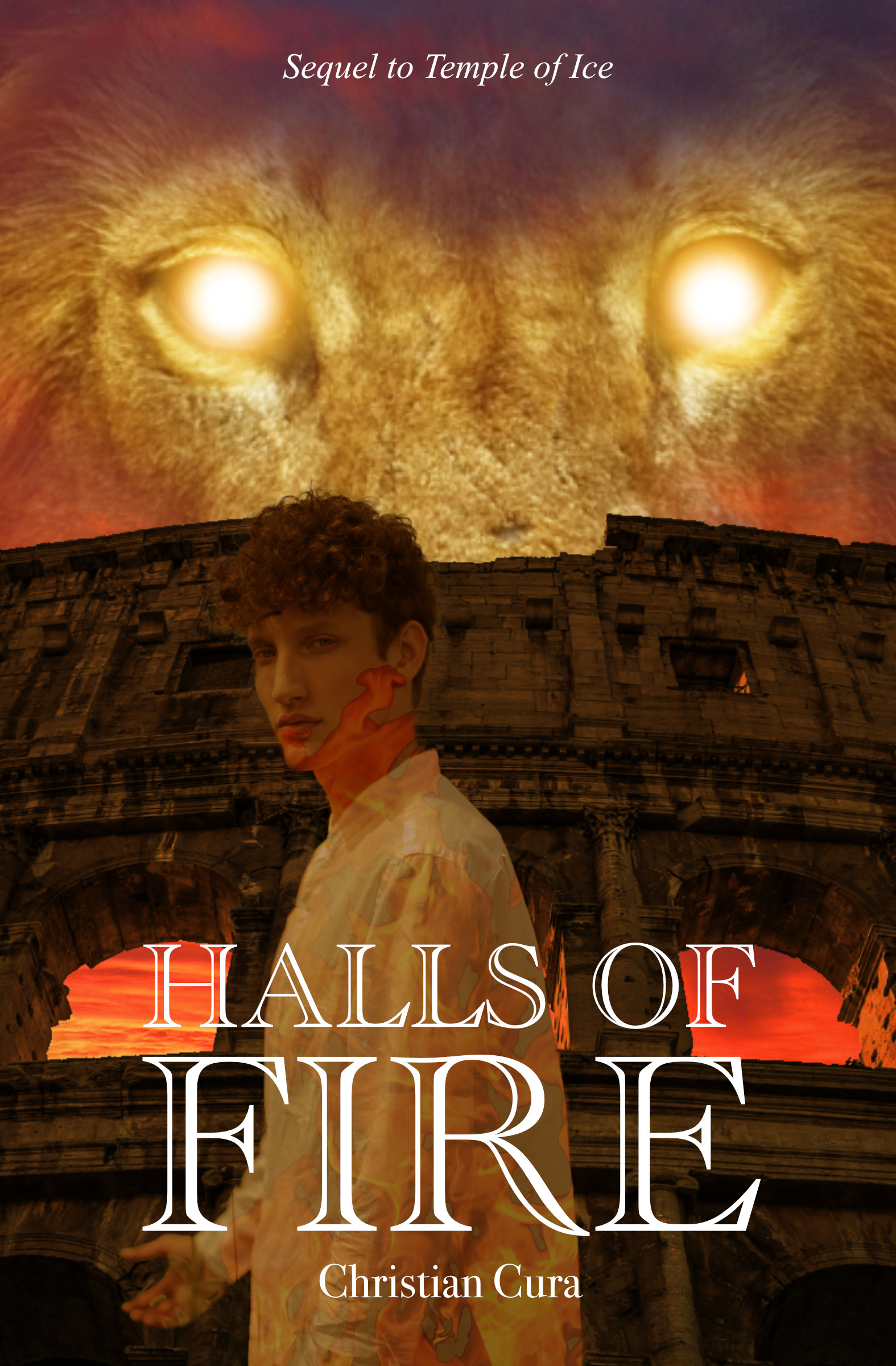
Interested in purchasing Halls of Fire?
Unfortunately, it is not yet available to purchase. Rest assured that when it is, I will add a link right here.


