
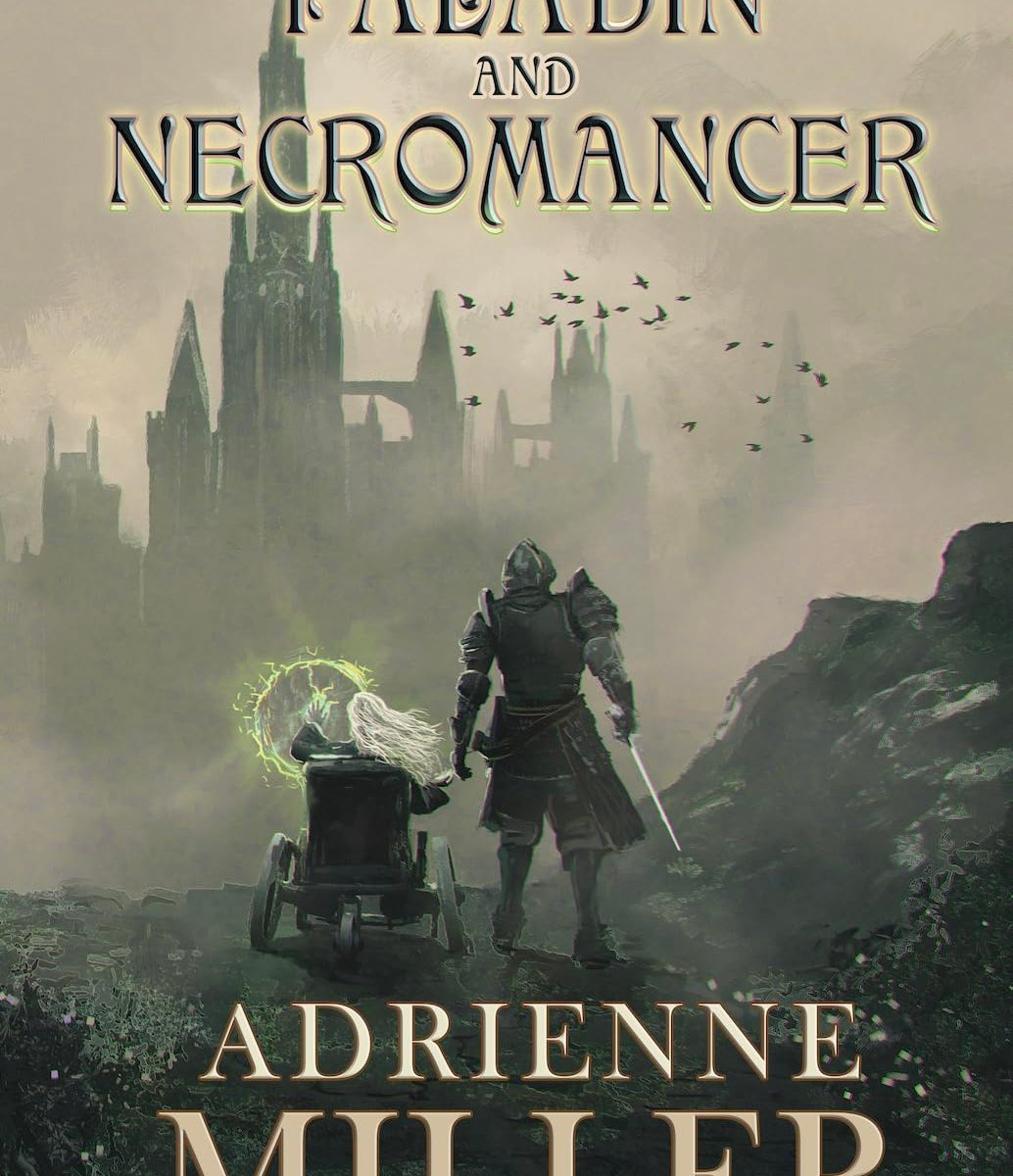

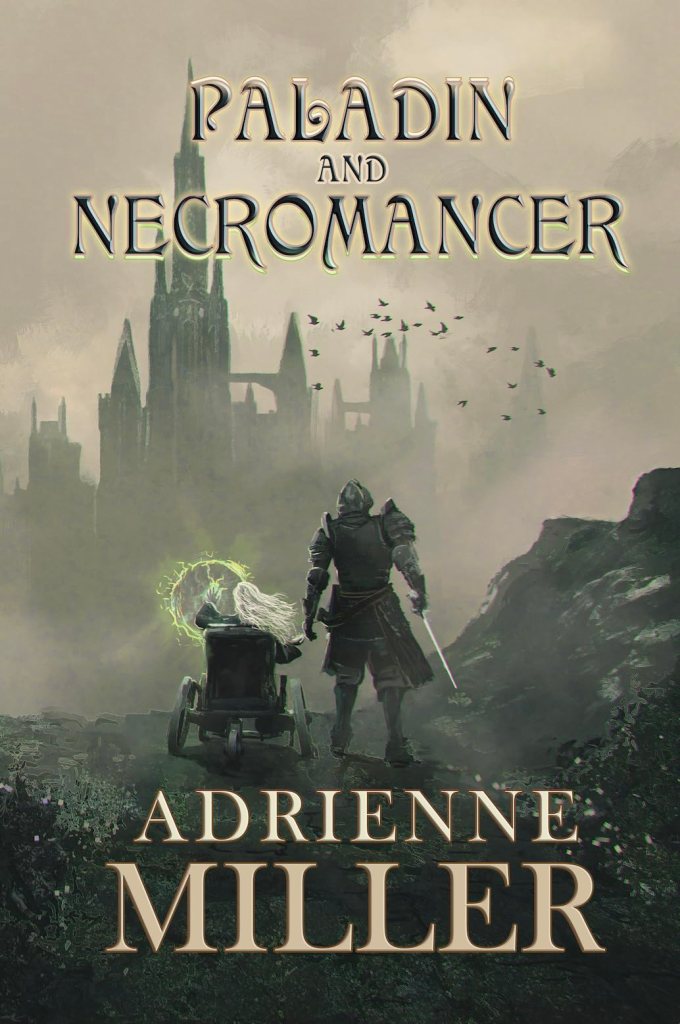

Written by Adrienne Miller
Some authors write books that bear a striking resemblance to one another, casting a familiar tone that provides a level of comfort to their returning readers. Other authors create wildly different worlds, jumping between genres in a way that ensures their returning readers will not know what to expect. Rarer is the author that returns to the genre—in this instance, dark high fantasy—and crafts an entirely different story. Adrienne Miller is one of these rare authors. Where her previous novel, The Travelling City is an exercise in psychedelia (you can read my review here), her new novel. Paladin and Necromancer is both a mystery and a romance story.
When one considers romance stories, the mind normally takes them to a young pair of characters who meet and fall in love. Paladin and Necromancer is not that story. This book isn’t about a meet cute; it isn’t about an oddly matched couple of characters finding love. Although the title—and to a degree, the novel itself—plays on the dichotomy of a paladin (for those unfamiliar with the term, the Dungeons & Dragons—which provides much of the book’s inspiration—equivalent of a knight) and a necromancer (with the mystical ability to raise the dead), it instead focuses on the complexities of a mature relationship. The titular couple has been married for a number of years. Their lives have taken a toll on their marriage, and their marriage has taken a toll on them.
Although the book is written with a sense of humour (which I’ll discuss later in this review), the romance is written with honesty that doesn’t glamourise either of the protagonists. The characters feel real, neither of them perfect (nor are any of the book’s characters), yet they are relatable. Kassander (or Kass), the paladin, lives with anxiety, while Silver, the necromancer, is a wheelchair user. Not only does the book explore mental health issues and physical disabilities, it also includes non-binary characters and looks at neurodivergency. The book is wonderfully inclusive, and while it could look like a checklist of representation, it is entirely natural. These elements strengthen the characters, while the characters make these elements feel real.
Throughout its 434 pages in paperback and hardcover (or its estimated 436 pages on Kindle), Paladin and Necromancer tells the story of a world slowly recovering from a multiversal war. Following the murder of a house of nobles, Kass and Silver work to uncover the mystery of what happened, leading them to a conspiracy. While the book is reasonably long, the plot and mystery aren’t particularly deep. They are engaging, but the book places its emphasis on Kass and Silver’s relationship more than it does with its plot.
As different as Paladin and Necromancer’s world and story is in comparison to The Travelling City, so too is the story’s presentation. Both books are of a similar length, with the earlier book being just five pages shorter. Yet while that book feels longer than its page count due to the picture it paints of its world, Paladin and Necromancer feels much shorter. Conventional wisdom assumes fantasy stories are long because of the way they illustrate their worlds, yet this isn’t always the case; something evidenced by the novel. It’s sparsely written and doesn’t take the time to enmesh the reader in its world.
The setting is a mediaeval land similar to what you would find in a Dungeons & Dragons world, but doesn’t feel rich or lived in. Silver uses a wheelchair and characters eat fast food, both of which didn’t exist in the period similar to the book’s setting. While mediaeval settings don’t need to exactly mirror mediaeval times, the book doesn’t connect these disparate elements to its setting. While the book’s world and history are interesting, and its use of the multiverse adds an entertaining element to the setting, the world itself doesn’t feel rich, and took me out of the story. If the book spent more time describing its world, it could have felt more whole.
In lieu of providing much detail about the world, much of the writing is dedicated to the dialogue. The characters all have unique voices, which makes following the conversations easy. It is through the dialogue that most of its humour comes through, with characters offering witty one liners and snappy retorts throughout. The humour throughout these exchanges works well, and should entertain most readers. As the characters banter back and forth, for all the comedy it elicits, it means the conversations don’t ring as true as they could. Despite this, the dialogue never manages to undercut the book’s heart or its darkness.
Paladin and Necromancer is, first and foremost, a story about its titular characters. Through them, it provides a romantic story that is both dark and humorous, filled with characters who feel like real people. While the character work throughout the book is fantastic, the plot doesn’t come together as well. The book is lightly written, and while it is certainly entertaining, it doesn’t draw the reader into its world as well as it could.
Favourite Passage
His squires are radiant, their skin translucent as their souls resonate with the world’s core. They speak little and spare fewer glances for each other than usual. Their eyes are dull as they glide across the windswept planes. Even Amaya seems disconcerted at their changed mood and remains close to Silver.
Paladin and Necromancer, Chapter 29
Paladin and Necromancer was provided by the author for the purpose of an honest review.
Paladin and Necromancer is available in both paperback and Kindle forms, exclusive to Amazon.
Note: I do not post scores for reviews on this website, but do post them on my Amazon and Goodreads reviews:
- Amazon
- Goodreads
You can follow Adrienne Miller online, via:

Interested in purchasing Paladin and Necromancer?
Please find a link below; please note I do not collect any proceeds from the sale.
Paladin and Necromancer
 wastanley.com