
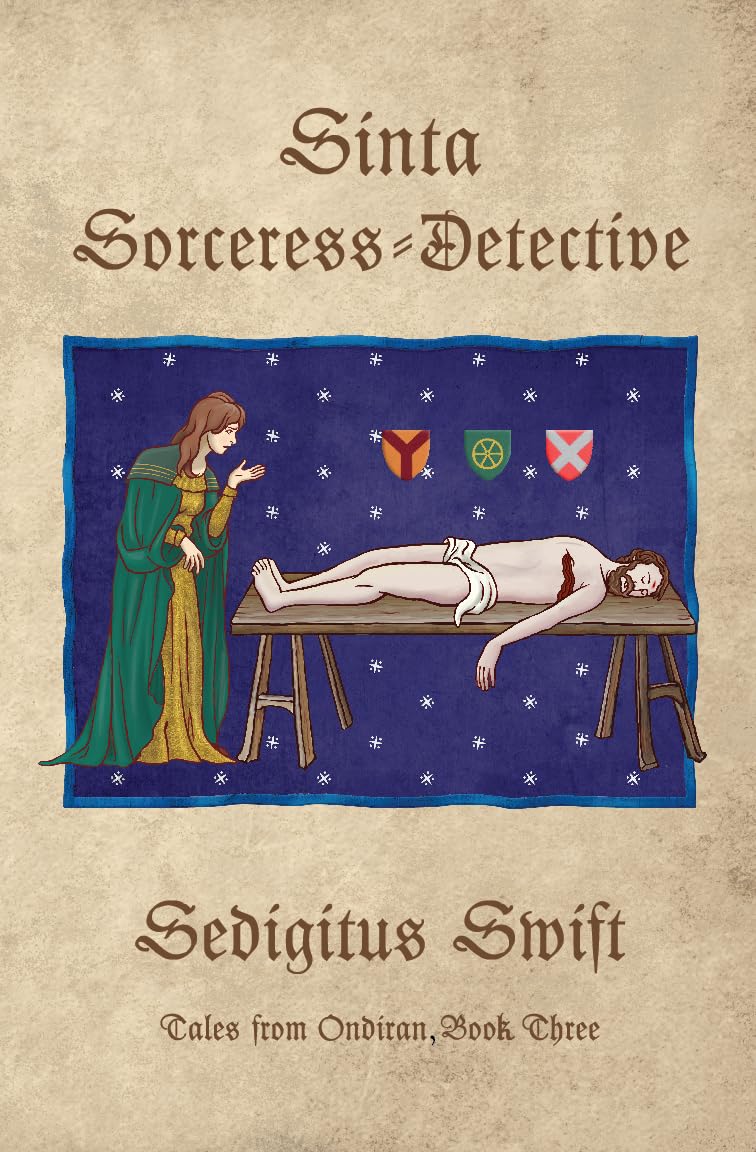

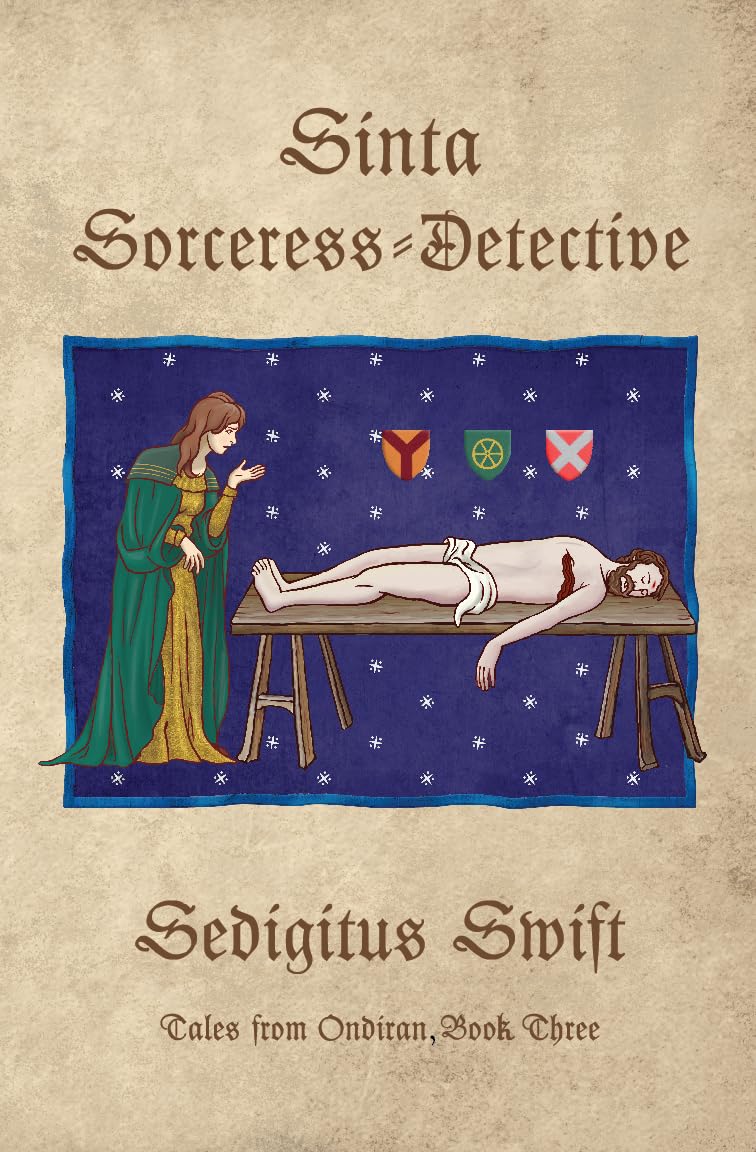
Written by Sedigitus Swift
Sedigitus Swift’s Tales from Ondiran are genuinely funny novellas. The Eye of Ksera (you can read my review here) and Sorceress for Hire (and that review, here) present a slyly humorous fantasy world as seen through the eyes of the series protagonist, the young sorceress, Sinta. In these books, Swift guides readers through the stories, deftly building humorous moments that build to the punchline, then bringing it home as it turns fantasy tropes on their head. Sinta, Sorceress-Detective continues this approach; however, with “Detective” in the title, it also turns its head to the tropes readers would find in a mystery.
In splitting the story into different genres, Sinta, Sorceress-Detective has less space to focus on either one. The result is a story that doesn’t trade as heavily on its world, and in doing so, doesn’t feel as refreshing. It’s still the same Ondiran that readers will know—and presumably love—from the first two books, but it feels like less of a character this time around. Although the book’s mystery element use much of the space that would otherwise be dedicated to the fantastical elements, it doesn’t build a deep mystery, instead playing like a cosy mystery on the surface.
The biggest reason the two elements don’t come together is by virtue of the book’s length. At an estimated 150 pages on your favourite eReader, it’s just one page longer than Sorceress for Hire’s 149 pages, and noticeably less than The Eye of Ksera’s 184 pages. While the short length works perfectly for those two books, it deprives Sinta, Sorceress-Detective of some additional space it could have used to make these elements stand out.
Likewise, the book’s length doesn’t help its plot. While the aforementioned books’ length were enough to tell their stories, Sinta, Sorceress-Detective’s doesn’t allow for twists and turns, and instead, the primary focus is on Sinta interviewing suspects. Like those books, it allows for the book to be read quickly, without overstaying its welcome, but this is an instance where more of it would have benefitted the overall story. While it’s true that many cosy mysteries are novellas of similar lengths, those aren’t usually built around comedy, and don’t have punchlines they’re building towards.
When humour plays such a pivotal role in a book, its plot only accounts for so much. And although Sinta, Sorceress-Detective’s plot doesn’t work as well as its predecessors’, the humour is just as strong. Swift’s prose oozes humour through its every sentence, each one written in a way that puts a smile on the reader’s face. The writing is clean and crisp, and although the prose is more verbose than most novellas, it’s in service of the book’s humour. Throughout the book, the writing is packed full of wit that encompasses its every passage. The jokes flow freely and build upon each other well. Humour is always subjective, but fans of dry wit will find so much to love. As with the other books, each chapter is introduced with a passage from in-universe books, adding more humour and colour to the tale.
It isn’t only the book’s prose that conveys its humour; the dialogue is also a constant source of delight. While the book’s blending of fantasy and mystery tropes interfere with the story being told, the dialogue fits with both genres. The characters both sound as though they stepped out of an epic fantasy and a mystery book. They feel as though they come from a mediaeval setting while also dealing with a modern mystery. The dialogue blends this with contemporary stylings for a sound that is unmistakably from the Tales of Ondiran. Each character sounds distinct, and each has been given their own brand of wit. The conversations and interrogations flow together elegantly, sounding natural while dripping with comedic value.
The best-written dialogue won’t ring true if it doesn’t have strong characters to back it up. By virtue of Tales from Ondiran’s styling, the characters in Sinta, Sorceress-Detective aren’t deep; not even Sinta, who has been explored in two previous books. The characters don’t need to be deep to work well (and exploring them in more depth would slow these books down), and the novella is a wonderful example of how to keep characters light without making them feel less engaging. Each character is a delight to follow, bringing levity with them while contributing to the overarching story.
Another reason for Sinta not being a deep character is that each book within Tales from Ondiran is free-standing. These books are designed to be read independently of each other, in any order. The result limits the protagonist’s ongoing character arc and growth from story to story, but it doesn’t destroy it; longtime readers will still see a degree of this. Readers returning from the first two books will see some reward for reading from the beginning, but readers jumping into Sinta, Sorceress-Detective without having read the first two books will feel at home. The book tells readers all they need to know without requiring any further reading.
Sinta, Sorceress-Detective is the first book in the series that suffers from its low page count, with the mix of genres and plot not working as well as they could have with more space. But Tales of Ondiran’s primary focus has never been on its genre or its plot; it’s all about the humour. Once again, this book’s humour leaps off the book’s page and keeps the reader chuckling throughout. Whether it’s through the prose, the dialogue, or its characters, this novella’s humour leaps from the page. It’s almost enough to make up the book’s weaker elements.
Favourite Passage
The next suspect on Sinta’s list was Sir Rodor, the falconer, who had made such unpleasant threats regarding the disposition of Lord Alfron’s testicles. Sinta knew the man slightly and liked him. She had gone with him to the mews once to see the prince’s hawks and falcons—beautiful creatures, she thought, though also alarming with their sharp beaks and unforgiving talons. Like Halifor, Sir Rodor had no valet, for he insisted that he had been perfectly capable of dressing himself since he was a small child, thank you very much. Fortunately, he did have a young assistant named Fovil, whom he was training to be a falconer himself one day.
Sinta, Sorceress-Detective: Tales from Ondiran, Book Three, Chapter 10
Sinta, Sorceress-Detective: Tales from Onidran, Book Three was provided by the author for the purpose of an honest review.
Sinta, Sorceress-Detective will be available in paperback and eBook, from retailers, including—but not limited to—Amazon from 1 March 2024.
Note: I do not post scores for reviews on this website, but do post them on my Amazon and Goodreads reviews:
- Amazon
- Goodreads
You can follow Sedigitus Swift online, via:
Interested in purchasing Sinta, Sorceress-Detective?
Please find a link below; please note I do not collect any proceeds from the sale.
Sinta, Sorceress-Detective (Tales from Ondiran – fantasy humor series)
 wastanley.com