

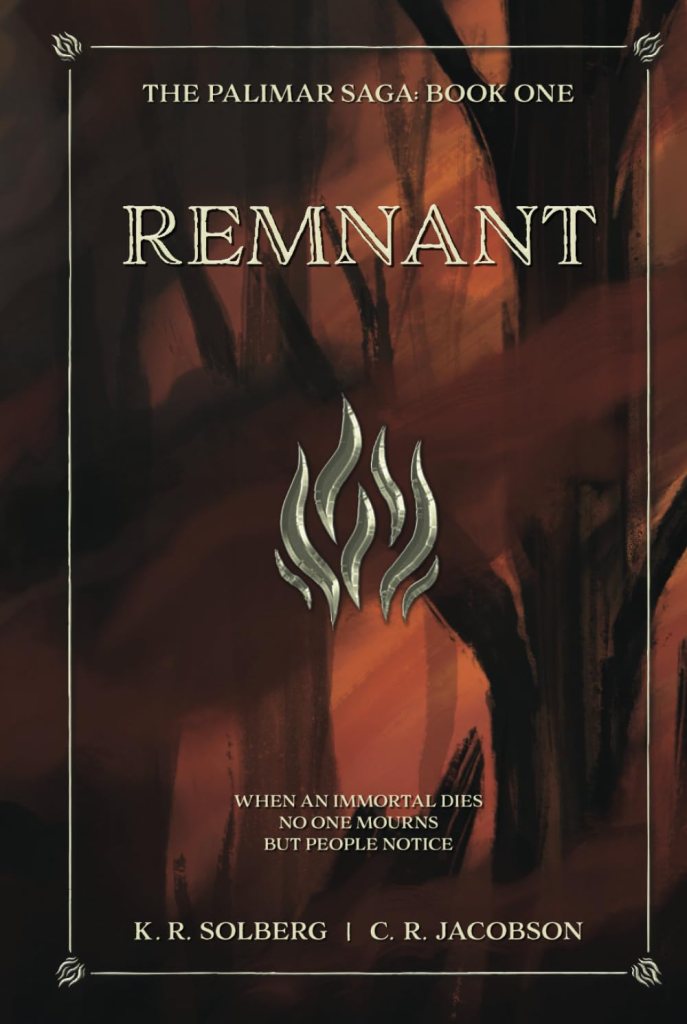
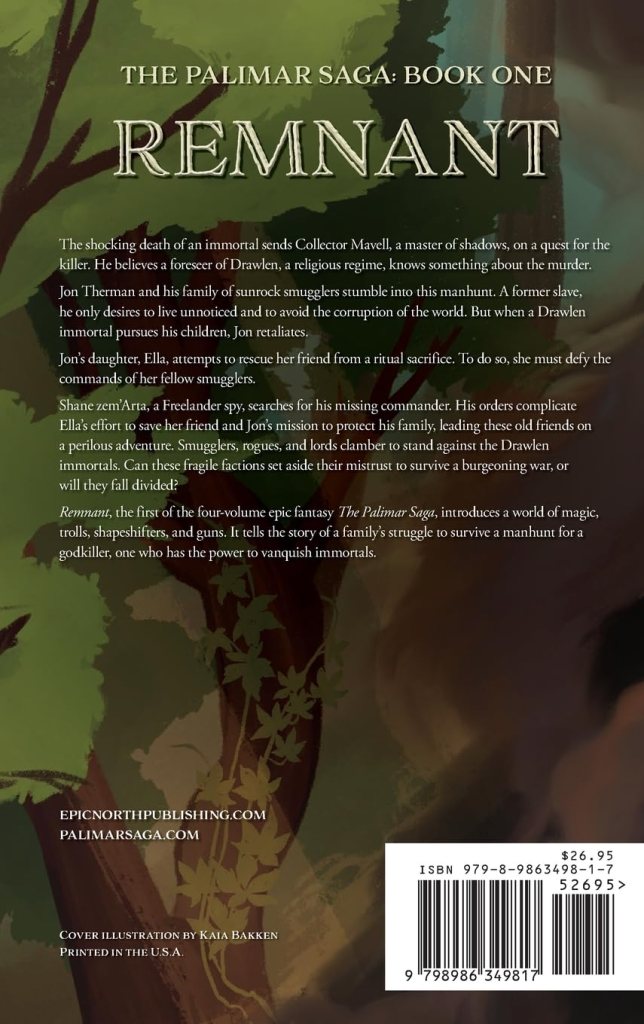
Written by K.R. Solberg and C.R. Jacobson
Click here to view the Remnant trailer
Epic fantasy novels are known for creating vast worlds populated by massive casts of characters. While some might be light and others, dark, readers have a fair idea of what they’re stepping into. Remnant, the first book in mother and daughter team K.R. Solberg (daughter) and C.R. Jacobson’s (mother) four volume Palimar Saga is no different in this respect. The novel brings with it many of the tropes fans of epic fantasy expect from the genre, in a sprawling tale that’s deserving of the epic fantasy moniker.
Clocking in at 430 pages in paperback and hardcover (or an estimated 452 pages in its eBook form), Remnant is a sizable read, if well within the bounds readers expect from the genre. As is common in these stories, a good portion of the novel is dedicated to building the world in which the tale takes place. In this instance, the world is Palimar (from which the series takes its name). Unlike the European mediaeval setting that so many fantasy books share, Palimar feels more modern in some ways, but also sits outside of time in others. The authors have created a world that feels distinct from what’s come before, while avoiding feeling so different that it will turn off readers of the genre. As most epic fantasy readers love, the book opens with a map of Palimar that shows the breath of the world; however, it’s only through the novel’s exploration of this world that the reader can take it in and truly appreciate the magnificent scope of the world, with all the details the authors have added.
An issue that fantasy books often encounter—particularly with the first book in a series—is establishing the world in context of the story. Remnant falls into this trap early on in the book, introducing the readers to the world and outlining the rules that govern the tale, at the cost of bringing the story to the forefront. Unlike many of the other books that don’t get the balance quite right, however, Remnant finds a balance after around the first act. When the story kicks into gear, the pacing moves quickly, moving from plot point to plot point deftly, and maintaining its momentum.
The plot has many of these points to jump between. What begins as a simple manhunt for the murderer of an immortal soon grows as it brings more characters to the fore, many of whom join the hunt, while others have a connection to the mysterious murder. The plot expands to include a mysterious religious order, characters condemned to ritual sacrifice, and missing spies. It’s a lot to keep track of, but the novel rewards the reader for their effort, with the elements coming together nicely. The story is on the darker side of fantasy, filled with morally grey characters and situations with no easy answers. Yet it never feels bleak, nor does it venture into grimdark territory.
Not only are there a number of plot points to keep track of, Remnant also features a massive cast of characters for readers to follow. Although this can feel slightly unwieldy, it never reaches the point where most readers will feel lost. With a cast as large as this novel’s, some characters will inevitably be explored in less detail than others. Despite this, however, none of them feel thin. Not every character is three dimensional, but the characters who play a large role in the book all are. The character work is fantastic, with the major players having a true sense of depth to them, and the book explores these characters wonderfully.
Unfortunately, as strong as these characters are, their dialogue doesn’t feel entirely natural. Conversations between the characters feel stilted and lack the flow that exists in real life conversations. The dialogue’s shortcomings are highlighted further by the novel’s prose. The prose is diametrically opposed to the prose, which captures the magic of Remnant’s fantasy landscape and the story’s dark undercurrent. It lures the reader in, making it difficult to put the book down.
If you follow my reviews, you may have picked up on me being a sucker for supplementary material in books. Remnant offers a wealth of additional material, coming in at 36 pages on my eReader (noting the physical copies will be different, and everyone’s device and settings will be different). First up, the book includes an exhaustive index of characters and terms used throughout the novel. This is followed by no less than six appendices. These provide additional information and context about the races who inhabit Palimar, the various nations and regions in the world, details about the characters who populate the book as well as historical characters referenced within, the various occupations throughout Palimar, the rules of the magic system explored though sorcery and the various crafts, and an exploration of the world and culture, history and religions. Whilst this is not necessary to enjoy the book, for readers who enjoy learning more about the world, it’s a wonderful bonus.
Although Remnant is the first book in the Palimar Saga, it stands alone to a substantial degree. Not every element in the book is wrapped up neatly, and there is far more of this world for its authors to explore. The book feels like a complete adventure, and readers won’t feel as though they’ve only read a quarter of the story.
Remnant offers readers a dark, epic fantasy set within a unique world. Although the pacing doesn’t entirely work in the book’s first act and the dialogue doesn’t feel natural, the beautiful prose guides the reader through a strong plot and introduces readers to the story’s nuanced characters.
Favourite Passage
Rose squinted through her fog of tears. She sprinted past the silent encampments and the outermost streets of Drawl. She pushed through the burning pain in her side and ignored the urge to vomit.
Stumbling, she collapsed to her hands and knees in a stinking puddle. Her shoulders shook, and she sobbed. A lifetime passed until boots clicking on cobblestone startled her. Slowly, she raised her head.
Remnant: The Palimar Saga: Book One, Chapter 22: “Encounters”
Remant was provided by the authors for the purpose of an honest review.
Remnant is available in paperback, hardcover and eBook from retailers, including—but not limited to—to Amazon.
You can follow K.R. Solberg and C.R. Jacobson online, via:
You can follow K.R. Solberg online, via:
Note: I do not post scores on reviews on this website, but do post them on my Amazon and Goodreads reviews:
- Amazon
- Goodreads
Interested in purchasing Remnant?
Please find a link below; please note I do not collect any proceeds from the sale.
Remnant: The Palimar Saga: Book One
 wastanley.com