


Written by Ilbert d’Orcence
Some books defy all semblance of logic, breaking the conventional rules of storytelling to do their own thing. Sometimes, this is the result of the author being unaware of the rules they’re breaking. More often, the author aims to project a certain feeling to their tale but can’t quite make it work. As its title suggests, Ilbert d’Orcence’s Kakapo and the Fiery Sundown Case of the Berjudas Hellhole Triangle is one such book that stands in defiance of logic. Yet, it falls into a third category of these books: one where the author knows exactly what they are doing; breaking the rules for striking effect. For ease, I’ll shorten my references to the book’s title to Kakapo, and as I do it, I already feel as though I’m losing part of this effect.
The author’s note that preempts the story says, “I’m not a writer. I’m a puzzle maker,” and the quote is no hyperbole; it’s a fantastic way of preparing the reader for what’s to come—or hinting at it, as there’s no way to fully prepare the reader without spoiling the book. Although it tells a story—broadly a tale set in the distant future, where humanity retreated following a disaster… and that’s as much as the plot as I’m willing to give away—Kakapo is less of a narrative adventure and more of an experience.
Whether it’s the formatting of the eBook (a fixed layout stretching 175 pages) which defies conventions with a non-serif font and left-aligned text in place of justified, its unconventional use of capitalisation, spaces separating words, or long, run-on sentences filled with adjective after adjective, Kakapo forces the reader to pay attention. The result of this is a book that feels foreign, where the reader needs to piece the language together as they move through it. This requires a little more work to interpret the words than in standard prose, but as they continue, the reader adapts to the book’s style, learning the book’s language. It’s an investment, but one that is incredibly worth the effort upon reaching the end.
Because of the book’s narrative style, it would be easy for readers to dismiss the book, or put it in the too hard basket before moving onto something more conventional. It’s a book that won’t resonate with everybody; but more adventurous readers who enjoy strange tales that stand apart from everything else will delight in it. Kakapo’s long sentences run from one moment to the next, with each paragraph representing a passage of time. It creates the effect of a stream of consciousness, feeling random in the moment, but making sense in the overall tapestry being created by the author. Through this, the book guides the reader through the story, touching upon many genres—fantasy, science fiction, humour, horror, and literary fiction—while avoiding the tropes readers expect from these. Kakapo is wholly unique.
Readers who follow these reviews would be used to me discussing a book’s characters and dialogue. These elements, however, are irrelevant to enjoying Kakapo. While the book features a generous helping of characters—particularly for a novella (if you can call this one) of this length—the book doesn’t doesn’t hone in on them. It instead stands more aloof, providing a macro view instead of zooming into the micro. Perhaps its biggest character is the narrator chronicling the events for the reader. Although the book does include some dialogue, it’s sparring, and defies expectation as much as the book’s prose, to the point where it’s not formatted as dialogue, and is expressed within its paragraphs.
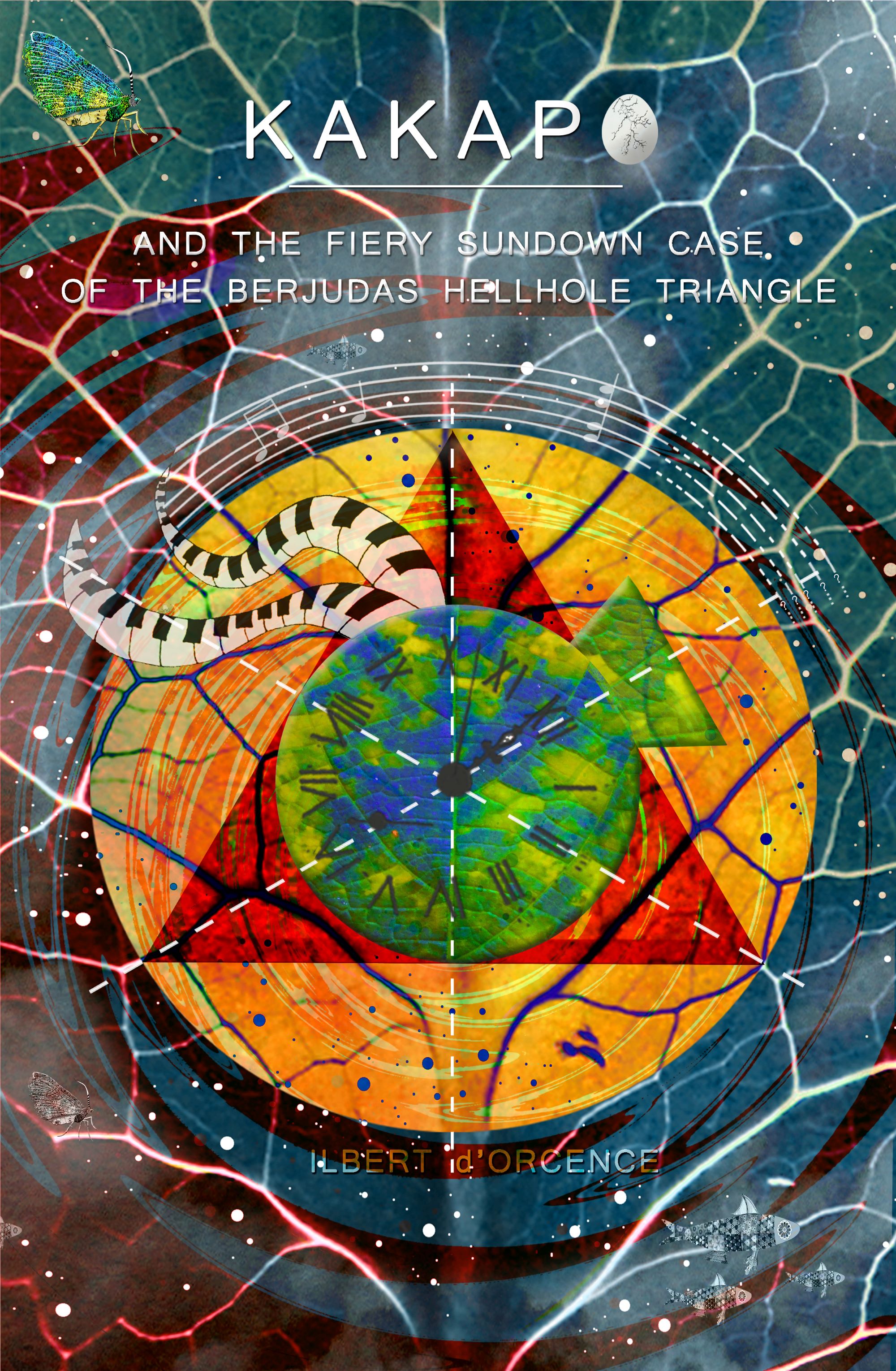
Another area I should touch upon is the artwork within the book’s virtual pages. Not only is Kakapo a rare example of an illustrated novella, it takes advantage of its eBook format and presents the artwork in full colour. The images lean more into expressionism than literal representations of the book’s words, but help convey the mood that the story projects. The images are stunning, and although the book doesn’t require them, they work with the text to convey the story’s mood.
I’m a big fan of books including additional material outside of the story, and Kakapo doesn’t disappoint. Before the story, it provides an overview of the characters and places readers will get to know throughout it. The book’s back matter provides a little more detail about the characters and places, but more interestingly, the author’s inspiration for them. It’s written in the style of the book’s prose; a fun inclusion that ensures the spirit of the book isn’t dropped at any point.Kakapo is a unique experience unlike anything I’ve read before, and probably just as different to anything I will ever read again. Its expressionist nature means it won’t be for all readers, but those who enjoy stories that stretch what’s possible with the English language will find a book that is truly interesting. Whilst describing a book as a work of art is both overused and underused, Kakapo is just that. A book that takes the art of storytelling and turns it on its head.
Favourite Passage
18:09:28: – MIRACLE! IT’S A MIRACLE! A Saint Scylla’s miracle! We have ALL BEEN SAVED! Saved by her loyal apostles who harried the venomous devil back to his lair! VADE RETRO! Vade retro evil satan, for this place cannot be taken! Rejoices Friar Tobias, blessing himself three times with the sign of the cross, almost breaking with the feverous prayer his huge canines that spark alive as he shakes mad his massive hippopotamus head, hurling the hairy knees of his plump red squirrel’s body against the hard pavement. Overcome by a pious emotion so shattering that cheekily trembles his huge jaws, the rattled abbot kneels down near the fountain, and repeatedly raising his furry paws joint in prayer to the six huge beasts, approaching with a little more restraint the egregious serpent, launches with an interpretative freedom worthy of an intricate contemporary ballet, into a lyrical kinesis of repeated bows and kisses of gratitude, swinging magnificent his fluffy vermilion tail as he walks the rough cobblestones of the holy ground on his kneecaps, moving towards the great circular tank that luckily rests not too far away, looking to soothe with the sweet noble water the throat wrecked by the recently extinguished martyrdom, and thunderous praising.
Kakapo and the Fiery Sundown Case of the Berjudas Hellhole Triangle, First Act
Kakapo and the Fiery Sundown Case of the Berjudas Hellhole Triangle was provided by the author for the purpose of an honest review.
Kakapo is available in eBook from retailers, including—but not limited to—to Amazon.
Note: I do not post scores on reviews on this website, but do post them on my Amazon and Goodreads reviews:
- Amazon
- Goodreads
Interested in purchasing Kakapo?
Please find a link below; please note I do not collect any proceeds from the sale.
KAKAPO : and the fiery sundown case of the Berjudas Hellhole Triangle
 wastanley.com